Flip over any jar or bottle in the women’s wellness aisle and you’ll meet a small botanical parade: wild yam, ashwagandha, chasteberry, maca, black cohosh. Some of these plants have been part of women’s wellness traditions for centuries; others are newer arrivals with early but genuinely interesting research behind them. If you’ve ever wondered what these plant-based ingredients for hormone balance actually are — and what the science does and doesn’t say — this guide is for you.
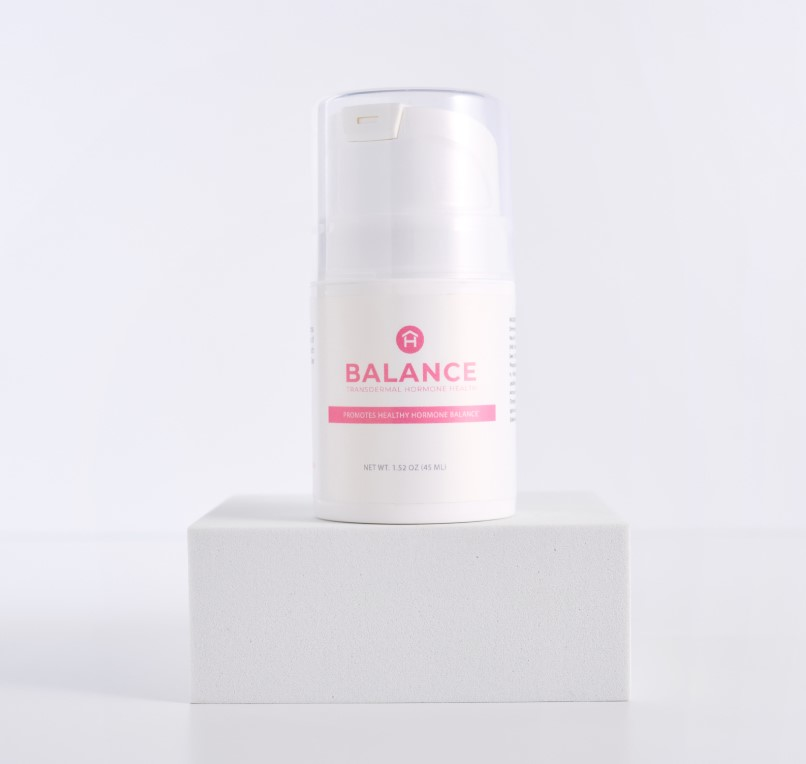
Below, we walk through the key botanicals in the BALANCE formula one at a time: what each plant is, why it earned its reputation in women’s wellness, and what researchers are exploring. Then we’ll explain why we deliver them as a transdermal cream — applied to the skin rather than swallowed. If you’re at the very beginning of this journey and still figuring out what’s changing, you may want to start with our guide to the signs of perimenopause and circle back here.
First, a promise about honesty
Botanical research is real science, but it’s often early-stage, small, or mixed. So throughout this post you’ll see careful phrases like “studied for” and “traditionally used” instead of promises. No plant switches off hot flashes on command, and any product that guarantees results deserves your skepticism. What botanicals can offer is gentler: a long history of traditional use, a growing body of research, and, for many women, welcome support through a season of change. That’s the honest frame. Now let’s meet the plants.
The plant-based ingredients for hormone balance, one by one
Wild yam (Dioscorea villosa)
Wild yam is a twining vine native to North America, and its root has appeared in women’s wellness traditions for generations. Its claim to fame is diosgenin, a plant compound with a fascinating history: in the 1940s, chemists discovered they could convert diosgenin into progesterone in the laboratory, a breakthrough that helped shape modern medicine. Here’s the part worth being honest about — that conversion only happens in a lab. Your body cannot turn diosgenin into progesterone on its own, so wild yam is not a hormone and shouldn’t be sold as one. What it is: a time-honored botanical, studied for its role in comfort during hormonal transitions, and a longtime staple of women’s wellness formulas. That’s exactly how it appears in BALANCE.
Ashwagandha (Withania somnifera)
Ashwagandha is a small shrub used in Ayurvedic tradition for well over a thousand years, prized as an adaptogen — a class of herbs studied for how they may help the body respond to stress. Modern research has explored ashwagandha’s relationship with cortisol, the body’s primary stress hormone, with several small studies examining perceived stress and sleep quality. Why does that matter in a hormone-focused formula? Because stress and hormonal comfort are deeply intertwined: tense seasons of life have a way of amplifying the discomforts of hormonal change. We dig into that connection in our post on natural approaches to hormone balance.
Chasteberry (Vitex agnus-castus)
Chasteberry is the fruit of the chaste tree, a Mediterranean shrub whose use stretches back to ancient Greece. It’s among the most-studied botanicals for cycle-related comfort: researchers have examined its use for the monthly discomforts many women know well, including breast tenderness and premenstrual mood swings. Findings are encouraging but not uniform — which is typical of botanical research. For women whose hormonal story still includes a monthly cycle, as it does through much of perimenopause, vitex earns its place in the jar.
Maca (Lepidium meyenii)
Maca is a hardy root vegetable from the high Peruvian Andes, cultivated for more than two thousand years and traditionally taken for stamina and vitality. It’s a cruciferous plant — a cousin of broccoli and radishes — and notably contains no plant hormones at all. Small studies have explored maca for mood and energy in women navigating the menopause transition, and it’s a frequent companion in formulas designed for midlife, a season we explore in our guide to hormone balance after 40.
Red clover and soy isoflavones: the phytoestrogen story
Here we need a short science detour. Phytoestrogens are plant compounds whose shape loosely resembles estrogen, which lets them interact weakly with the body’s estrogen receptors — picture a key that fits the lock but turns it only slightly, far more gently than the body’s own estrogen. Red clover and soy are the best-known sources, both rich in compounds called isoflavones. Decades ago, researchers noticed that women in cultures with soy-rich diets often reported fewer hot flashes, and that observation sparked a long line of studies. Results have been mixed — some trials report modest comfort, others little difference — but interest remains strong, and isoflavones are now among the most-researched plant compounds in menopausal wellness. If nighttime heat is your main complaint, our guide to natural relief for night sweats pairs well with this section.
Black cohosh (Actaea racemosa)
Black cohosh is a woodland plant native to eastern North America, used by Indigenous peoples long before it became one of the most popular midlife botanicals in Europe and the United States. It has been studied for decades for menopausal comfort — hot flashes in particular — with, once again, mixed but ongoing findings. Interestingly, current evidence suggests black cohosh does not act like estrogen in the body; its mechanism remains an open scientific question. The NIH Office of Dietary Supplements maintains a detailed fact sheet on black cohosh if you’d like the deeper dive.
Flaxseed
Flax is one of humanity’s oldest crops, and its seeds are rich in lignans — a second family of phytoestrogens, distinct from isoflavones — along with omega-3 fatty acids. Researchers have explored dietary flaxseed for menopausal comfort with modest, mixed results. In a topical formula, flaxseed brings something extra: its oil is a classic skin-conditioning ingredient, helping a daily cream feel nourishing rather than clinical.
Clary sage and rosemary
These two aromatic herbs round out the formula. Clary sage carries a long folk association with women’s wellness, and small aromatherapy studies have explored how its scent relates to feelings of stress and mood. Rosemary is rich in antioxidant compounds and has traditionally been used to refresh and invigorate skin. Beyond the research, both serve an honest practical purpose: they make the cream a genuinely pleasant sensory experience — and a ritual you enjoy is a ritual you keep.
Why a cream? The case for transdermal delivery
Most botanical products come as pills, powders, or teas, so why formulate BALANCE as a transdermal cream? Three reasons. First, the route: the cream is massaged into areas where skin is thin — inner wrists, inner arms, the neck, or the abdomen — so its botanicals absorb through the skin rather than traveling the digestive system. Second, simplicity: another capsule is easy to forget and, for some women, hard on the stomach; a cream sidesteps both. Third, and in our view most meaningful: ritual. A quiet minute of self-care in the morning and evening becomes a small, steady anchor in the day — and consistency is where any wellness practice earns its keep.
If you enjoy the deeper science — skin absorption, formulation choices, and the research on each botanical — we’ve gathered it all in our white paper.
An ingredient label you can actually read
Our philosophy is simple: name every plant, explain what it is, and describe the research honestly — hedges and all. You’ll find the complete formula, actives and base ingredients alike, on our ingredients page, written in the same plain language you’ve read here. The federal Office on Women’s Health is another excellent, trustworthy starting point for understanding the menopause transition itself.
No botanical is a magic switch, and every woman’s experience of hormonal change is her own. But plants have kept good company with women’s health for a very long time, and modern research is slowly, carefully catching up to tradition. We think that story — told honestly — is compelling enough on its own.
This article is for informational purposes only and is not medical advice. Always talk with your healthcare provider about what’s right for your body, especially if you are pregnant, nursing, or taking medication.